Seeed Studio
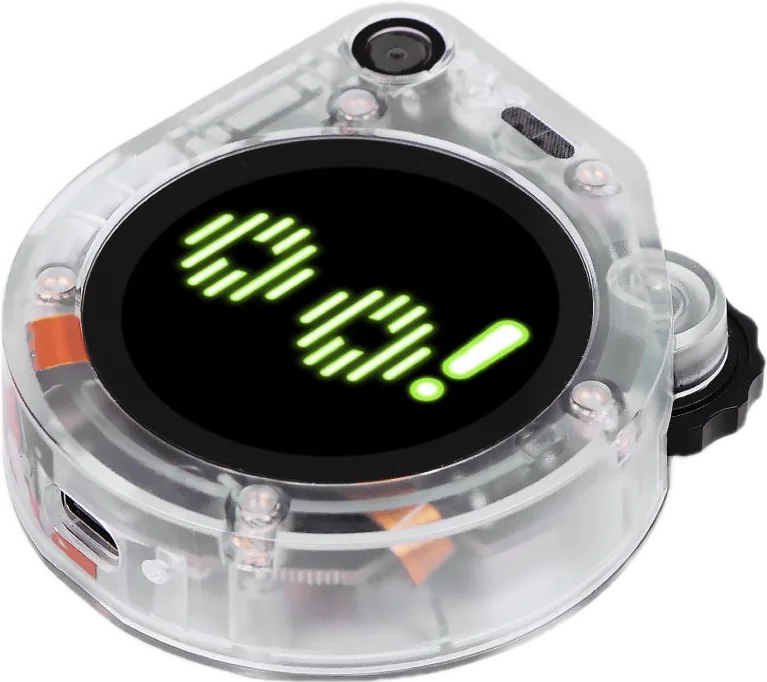
SenseCAP Watcher W1-A Watch a room and trigger something when a named thing happens, without sending video to a server.
Camera Touchscreen Computer vision Speaker
Bring along Mains USB-C power, a 2.4 GHz network, and a microSD card if you want it to keep anything.
Keep in mind Runs on mains — the battery is only a backup — and the camera is fixed focus at about three metres. Source checked · Sep 18, 2026 Image credit Maker product photo · SenseCAP Watcher W1-A clear enclosure · Seeed Studio
Overview Blueprint 2 Specifications 19 Resources 2
(02) Blueprint
What’s published Seeed's OSHW-SenseCAP-Watcher repo publishes the schematic as a PDF and the enclosure as a STEP file, but no editable KiCad/Gerber PCB source.
1 git clone https://github.com/Seeed-Studio/OSHW-SenseCAP-Watcher.git
Research notes Repo named 'OSHW' (open-source hardware) but only ships a schematic PDF and enclosure STEP, no kicad_sch/kicad_pcb/Gerbers/BOM; all linked files verified 200. Firmware SDK is a separate repo (Seeed-Studio/SenseCAP-Watcher-Firmware) not needed for hardware rebuild.
Every link checked 2026-09-27.
Hand this device to your agent. Everything on this page, as clean Markdown and JSON: specs, shops, prices, design files, parts.
Made the SenseCAP Watcher W1-A? Put the badge on your README; it links here, with every shop that sells it.
Copy Markdown
Processing 4 MCU ESP32-S3 at 240 MHz with 8 MB PSRAM AI processor Himax HX6538, combining a Cortex-M55 with an Ethos-U55 Flash 32 MB for the ESP32-S3 and 16 MB for the Himax HX6538 Storage microSD slot supporting cards up to 32 GB, FAT32 Sensing & output 5 Camera OV5647, 120° field of view, fixed focal length quoted at three metres Display 1.45-inch touchscreen at 412 × 412 Microphone Single microphone Speaker 1 W speaker output Controls A wheel supporting scroll up and down plus a button press; one RGB indicator LED; a reset button in the bottom hole Radio 3 Wi-Fi IEEE 802.11 b/g/n on 2.4 GHz; maker quotes up to 100 m in an open-space test Antenna Built-in Wi-Fi and Bluetooth antenna Power, expansion & mounting 7 Battery 3.7 V 400 mAh lithium cell, described by the maker as backup power USB-C One on the back for power only; one on the bottom for power and programming Expansion One Grove I²C interface and a 2×4 female header carrying I²C, two GPIO, two grounds, a 3.3 V output and a 5 V input Temperature 0 to 45 °C operating range Mounting Wall, desktop and bracket mounting; only the 360° rotate bracket ships with the device, and the 1/4-inch tripod bracket is sold separately Price checked US$60.99 at the maker's store No matching specification. Try a chip name, connector or feature.
What still needs checking The maker publishes no battery runtime on backup power, only the cell capacity. No figure is published for on-device inference speed, nor for which models run locally rather than on a server.
Downloads & docs
Source & revision notes Maker listing checked Sep 18, 2026. Detailed documentation reviewed Sep 18, 2026. Not hands-on tested.
Price is a dated listing; confirm with the maker.
The 400 mAh cell is described by the maker as backup power, not as a battery you run the device on. Treat this as a mains-powered device.
The two USB-C ports are not equivalent: the one on the back supplies power only, and only the one on the bottom can also program the device.
The maker quotes a 100 m Wi-Fi range as an open-space test and the camera as fixed-focus at three metres with a 120° field of view. Neither has been checked on our bench.
Only the 360° rotate bracket is in the box; the 1/4-inch tripod bracket is a separate purchase.
The maker describes a split architecture, with some processing on-device and some on a server. What leaves the device is a question worth answering before putting one in a private space.
Only the W1-A clear-enclosure variant is covered here.
Build or list hardware with us