Raspberry Pi
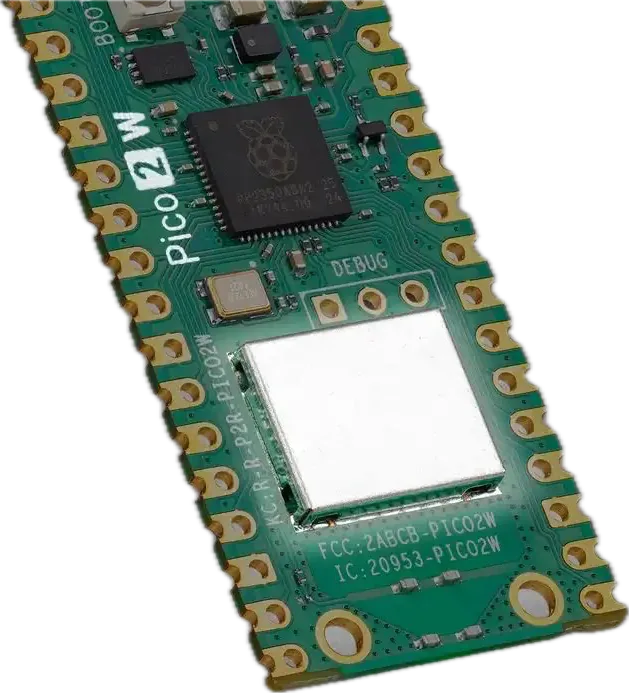
Raspberry Pi Pico 2 W Program a compact wireless controller in C/C++ or MicroPython.
Build & code Bluetooth LE
Bring along USB data cable, development tools and your sensors or actuators.
Keep in mind A microcontroller runs your firmware; it is not a Linux computer. Source checked · Sep 16, 2026 Image credit Maker image · wireless Pico 2 W · Raspberry Pi
Overview Blueprint 2 Specifications 20 Resources 6
(02) Blueprint
What’s published Raspberry Pi publishes the Pico 2 W schematic diagram and RP2350 datasheet, but unlike the non-wireless Pico 2 it does not release a KiCad/Allegro hardware-design-source archive for the W variant.
Research notes Confirmed via WebFetch of raspberrypi.com/documentation/microcontrollers: the non-wireless Pico 2 has a full KiCad/Allegro design-files zip, but the Pico 2 W page only links the schematic diagram, not a source archive. All PDF links resolved 200 via pip-assets.raspberrypi.com.
Every link checked 2026-09-27.
Hand this device to your agent. Everything on this page, as clean Markdown and JSON: specs, shops, prices, design files, parts.
Made the Raspberry Pi Pico 2 W? Put the badge on your README; it links here, with every shop that sells it.
Copy Markdown
Controller & wireless 5 Processor RP2350; dual Cortex-M33 or dual Hazard3 RISC-V, up to 150 MHz Memory 520 KB SRAM; 4 MB onboard flash Wi-Fi 2.4 GHz 802.11n; WPA3 and a soft access point for up to four clients Bluetooth 5.2; BLE central/peripheral and Bluetooth Classic in supported stacks Form 21 × 51 mm castellated board; micro-USB B for data/power I/O & development 8 GPIO 26 exposed 3.3 V GPIO; three support analog input Serial buses Two UART, two SPI and two I²C controllers Analog & timing Three 12-bit ADC inputs, 16 PWM channels and 12 PIO state machines Debug Three-pin SWD; pads on base board, keyed connector on header variant MicroPython Choose the Pico 2 W UF2 from the official download index Flash from USB Hold BOOTSEL while connecting; copy UF2 to the RP2350 volume C/C++ Official SDK, examples and VS Code Pico extension Header options Pico 2 W and Pico 2 W with headers; non-W Pico 2 lacks wireless Power & revision limits 7 USB power VBUS nominally 5 V; separate from the wider VSYS range External supply VSYS, pin 39: 1.8–5.5 V input Peripheral power 3V3 output: keep external load below 300 mA; available current varies Operating temperature −20 to 70 °C including self-heating, per board datasheet USB host Supply 5 V to VBUS for the documented host mode Multiple supplies Use the datasheet’s power-ORing circuit to avoid back-powering Silicon errata RP2350-E9 affects A2 GPIO input leakage; fixed in A3 No matching specification. Try a chip name, connector or feature.
What still needs checking Board input ratings do not make GPIO 5 V tolerant. The installed RP2350 stepping is unknown. Review applicable errata and firmware target before reusing a Pico 1 project. Wireless APIs depend on the selected SDK/firmware; no example was compiled or run here.
Downloads & docs
From the original makers Build with Raspberry Pi Pico 2 W Source & revision notes Maker listing checked Sep 15, 2026. Detailed documentation reviewed Sep 16, 2026. Not hands-on tested.
Price is a dated listing; confirm with the maker.
Wireless connectivity applies to Pico 2 W, not the non-wireless Pico 2. The shared maker page documents both versions.
Headers, connected sensors and a display are separate. Board power-input tolerance must not be mistaken for GPIO voltage tolerance.
Exact-model setup, electrical limits and revision resources were reviewed on 2026-09-16. Detailed rows retain their primary sources; listed prices keep the earlier check date.
Replaces the old −20 to 85 °C family-page value with the exact Pico 2 W board rating.
Build or list hardware with us Raspberry Pi Pico 2 W Raspberry Pi
Buy $7