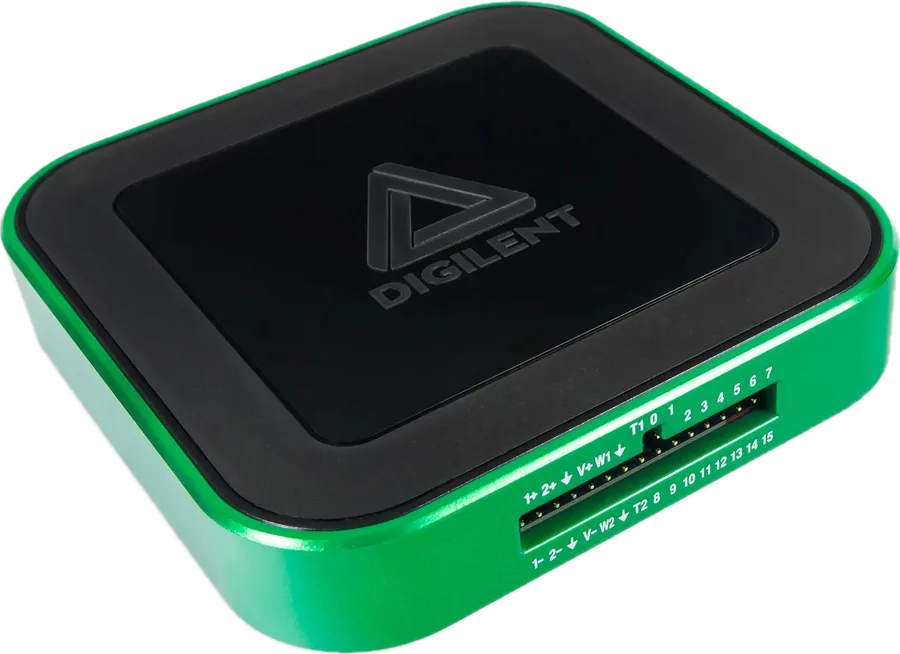
digilent.com and files.digilent.com (incl. the known_links datasheet and WaveForms manual) return a Cloudflare challenge 403 to curl and WebFetch here, so they are not cited. Used a TestEquity-hosted copy of Digilent's AD3 Reference Manual (HTTP 200, 8.8 MB PDF, text extracted with pdftotext): it says the unit 'features circuitry made by Texas Instruments' and references Xilinx's 7 Series SelectIO guide (UG471), but names no ADC/DAC part numbers and includes no schematic. No Digilent GitHub hardware repo or schematic download exists for AD3; forum threads asking for AD3 schematics exist (titles seen in search) but could not be fetched. Specific ADC/DAC/FPGA part numbers need a teardown.
Every link checked 2026-09-27.
Hand this device to your agent. Everything on this page, as clean Markdown and JSON: specs, shops, prices, design files, parts.
Made the Digilent Analog Discovery 3? Put the badge on your README; it links here, with every shop that sells it.
Specifications
Oscilloscope
8
Inputs
Two differential channels.
Resolution and rate
14-bit; up to 125 MS/s per channel.
Measurement range
±2.5 V or ±25 V relative to ground.
Analog bandwidth
9 MHz direct; 30+ MHz with BNC adapter, at −3 dB.
Input impedance
1 MΩ parallel with 24 pF.
Protection
±50 VDC / ±30 VRMS protection; not a larger measurement range.
Capture buffer
Up to 32,768 samples/channel; 65,536 with one analog input, configuration-dependent.
Streaming
Approximately 10 MS/s total to RAM or 5 MS/s to disk; host-dependent.
Generation and digital I/O
6
Waveform outputs
Two 14-bit channels, up to 125 MS/s; ±5 V.
AWG bandwidth
9 MHz direct; 12 MHz with BNC adapter, at −3 dB.
AWG load
Up to 30 mA DC drive.
Digital channels
16 individually programmable I/Os, up to 125 MS/s.
Digital levels
3.3 V outputs; 5 V-tolerant inputs; threshold setting is shared.
Target supplies
0.5–5 V and −0.5…−5 V; auxiliary-powered limit is 800 mA or 2.4 W per channel.
Power, accessories and pinout
9
Host connection
USB-C connector; USB 2.0 data rates.
USB-A host
USB 3.2-compatible power required unless auxiliary-powered.
Auxiliary input
5 V; 4 A recommended, 3.1 A minimum; 5.5×2.1 mm center-positive barrel.
Base kit
Device, project box, USB-C/C cable, 2×15 flywires, headers and labels.
Separate accessories
BNC adapter, probes, auxiliary supply and measurement adapters are optional.
BNC wiring
Adapter grounds the scope’s negative inputs; use BNC output leads rather than oscilloscope probes on the AWG.
Pinout
Official AD3 startup guide supplies the 30-pin map and per-function operating limits.
External clock
Trigger 1 accepts a documented 10–50 MHz reference in the configured clock mode.
Body
100×100×20 mm; 128 g; operating ambient 0–40 °C.
Software and setup
6
Application
WaveForms supports Windows, macOS and Linux; demo mode works without hardware.
Windows runtime
WaveForms installer includes Adept Runtime and USB support.
Apple silicon
WaveForms 3.25.1 manual describes an Intel app using Rosetta; its runtime supports arm64.
Linux runtime
Install the appropriate architecture’s WaveForms and separate Adept Runtime packages.
SDK and instruments
C/C++/Python control; LabVIEW/MATLAB support; scope, protocol and network/impedance tools.
Specification conditions
Generally typical after 30-minute warm-up at 25 °C.
No matching specification. Try a chip name, connector or feature.
What still needs checking
A complete board schematic was not found in the reviewed resources.
The datasheet and WaveForms startup table give different waveform-output protection figures; neither is presented here as a guaranteed external back-drive tolerance.
WaveForms 3.25.1 installer architecture is documented as reviewed; check the selected release before purchase or deployment.